Despite the protests, he admits using AI and then charging his clients full price...
"But maybe I will ask Claude’s opinion, and if one of the suggestions is smart—cutting a paragraph, for instance, or clarifying a sentence—I might accept it.
When I started translating 15 years ago, we used to paste uncooperative sentences into Google Translate to see if it had interesting ways to phrase things differently. Then came DeepL—same idea."
I do admit testing AI. Hell, most of the time, I don't have the choice anymore—I don't use it but several of my clients send AI-translated documents. Do I just send back a CHatGPT version? Hell no. This is why and how I know it's not reliable or good.
It's not exactly taboo to use AI, is it? IT doesn't have to be all or nothing. AI is great for my glossaries. AI is shit to translate.
I've been able to move away from most US suppliers, but they do still have the best stuff when it comes to CPUs, GPUs and LLMS. By now I'd expected that some ARM chip would be on par with AMD/Intel, but even disregarding compatibility, they aren't. You'd think there is some ML-capable chip on the market with crappy software but on par with NVidia; even disregarding software there just isn't. For some reasons the Americans make the best stuff. I'm not American myself, so there is zero nationalism involved. Just a frustrated buyer :) As a buyer, I'd like options.
Is the assumption that the LLM did the translation? Or that it just understood your query and submitted, on your behalf, to a tool you could have just used directly?
I think Technical posts should be written with 3 levels of audiences in mind. Expert, Middle, Beginner. But I guess that is not necessary, since AIs can cut the flab easily.
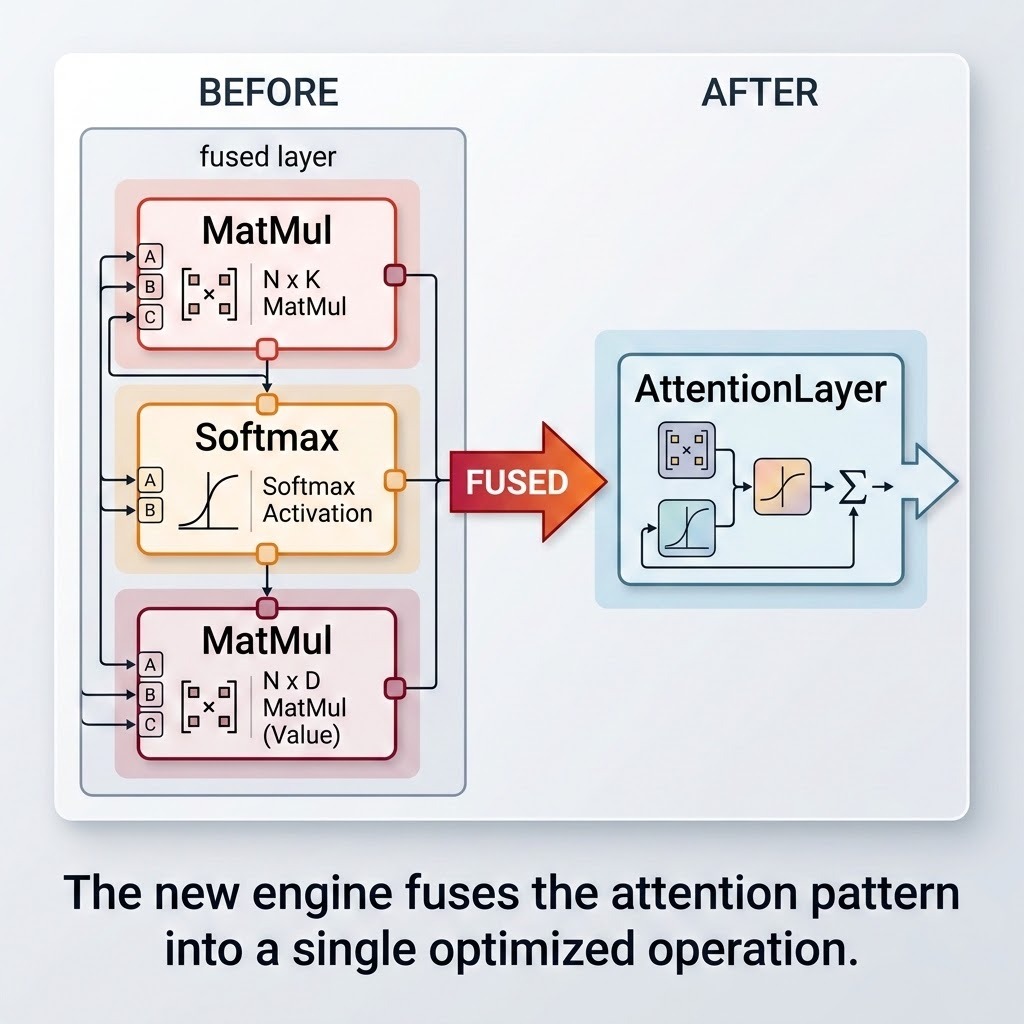
The diagrams were generated with Nano Banana Pro (most probably, or alternatively with ChatGPT Image 2), if you look closely in high contrast areas you'll see artifacts in the background that give it away.
I personally don't mind AI generated content when it's properly reviewed, but unfortunately more often than not the author just glances at the result and decides it's good enough.
I'm not knowledgable enough to determine whether this diagram is 100% accurate, but some things look off - the arrows in the bottom left seem superficial, some arrows are connected in weird ways, the mini diagram in AttentionLayer block doesn't look right (it has two Softmax icons and one MatMul icon, while the "before" diagram is the opposite).
As of now, any human effort is still ~= quality. Human-written article signals to me that a certain amount of time was spent on it, which is a proxy for quality. This goes for both text and diagrams.
If someone slapped together an article from an LLM and a few internal documents, that tells me exactly how much they cared about it.
So to-the-point that it comes with a table of contents. Idk if it needs saying that ToCs have legitimate uses, but the number of search results and blog posts having one since ~2022 is, eh, interesting. You come for whatever the headline was and you get a page with thousands of words, split up into five or more chapters, many of them overlapping or a rephrasing of the same question if you've hit a true content farm. This is not that, but I also can't fathom how one could argue that slop is concise as a hallmark
As for being well-written, does that refer to correct use of grammar and no typos, or do you mean that you find that bots write better than humans in any other way?
It could be the best written, most informative article they've ever read, but anti-ai folks would dismiss it as slop the moment someone told them it was written by ai.


reply