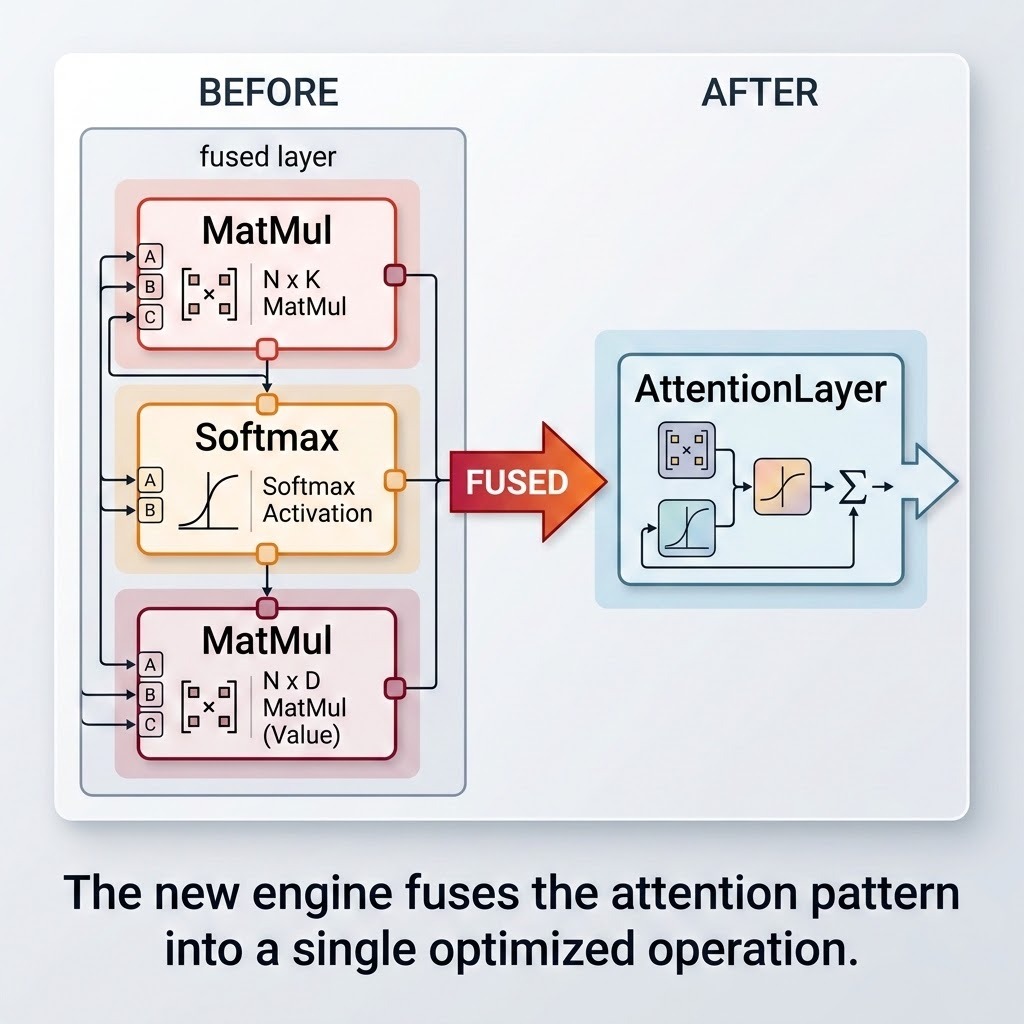
The diagrams were generated with Nano Banana Pro (most probably, or alternatively with ChatGPT Image 2), if you look closely in high contrast areas you'll see artifacts in the background that give it away.
I personally don't mind AI generated content when it's properly reviewed, but unfortunately more often than not the author just glances at the result and decides it's good enough.
I'm not knowledgable enough to determine whether this diagram is 100% accurate, but some things look off - the arrows in the bottom left seem superficial, some arrows are connected in weird ways, the mini diagram in AttentionLayer block doesn't look right (it has two Softmax icons and one MatMul icon, while the "before" diagram is the opposite).
I absolutely love the graphs that were used in old medical physiology papers. Something about the hand-drawn nature makes you appreciate both the underlying concept the graph is trying to convey as well as the work that went into it. Don't get me wrong, I'm a huge techie. I love computers and computer graphics, but sometimes a hand-drawn graph just takes the cake.
As a rule of thumb the larger the model is, the more you can quantize it without losing performance, but smaller models will run faster. It usually always makes sense to pick the larger model at a lower quant, as long as the speed is acceptable. Smaller models also use a smaller KV cache, so longer contexts are more viable. It really depends on what your use case is.
Imo though, going below 4 bits for anything that's less than 70B is not worth the degradation. BF/FP16 and Q8 are usually indistinguishable except for vision encoders (mmproj) and for really small models, like under 2B.
Some infections cause cancer-like growths or masses though they're not actually cancer. Though off the top of my head none that I would suspect would survive a trip through stomach acid.
This seems like something a liability waiver and an escrow account with money for body clean up (if things go bad) would solve. A little red tape, sure, but not illegal.
there aren't that many accidents. It's also more dangerous to jump in ways that attempt to skirt laws (jumping near dark, trying to evade capture, etc)
If it had been legal, and had he jumped in broad daylight, I think he’d have survived that day.
Right. It's the Park Service to blame. Right there with the "it's the cops fault I crashed and burned because if driving 140mph was legal I would be fine".
But to your point, when some overconfident dudebro splatters himself all over the flats, we the people have to pay for the cops to show up, the medics and the ambulance even if the idiot is obviously dogfood, the body recovery, the coroner and the postmortem, and all the associated bureaucracy.
And someone will still sue because the Park Service didn't prevent the moron from killing himself. You can sue for literally anything in the US.
To the best of my knowledge, there's no Rust-based compiler that comes anywhere close to 99% on the GCC torture test suite, or able to compile Doom. So even if it saw the internals of GCC and a lot of other compilers, the ability to recreate this step-by-step in Rust is extremely impressive to me.
What do you think warrants are? You think they get a warrant and they say, "Can you put your finger on the device?" You say, "No," and that's it? If all they wanted to do was ask you, they would just ask you without the warrant.
> 52. These warrants would also permit law enforcement to obtain from Natanson the display of physical biometric characteristics (e.g., fingerprint, thumbprint, or facial characteristics) in order to unlock devices subject to search and seizure pursuant to the above referenced warrants
> 60. Accordingly, if law enforcement personnel encounter a device that is subject to search and seizure pursuant to the requested warrants and may be unlocked using one of the aforementioned biometric features, the requested warrants would permit law enforcement personnel to (1) press or swipe the fingers (including thumbs) of the Subject to the fingerprint scanner of the device(s); or (2) hold the devices in front of the Subject's face for the purpose of attempting to unlock the device(s) in order to search the contents as authorized by the warrants
So yes law enforcement had the right to grab her hand and press it against the laptop to unlock before seizing it if that's what they had to do.
It'd certainly be a good first step to figure out how to identify whether or not the PDF you're linking to is in fact a warrant at all before trying to educate others on them.
"...the requested warrants would permit law enforcement personnel to (1) press or swipe the fingers (including thumbs) of the subject to the fingerprint scanner of the devices..."
As far as I know there is no link between, say, talk.bizarre and weird Twitter, but it's a sign that the same basic impulses are universal. I'm sure that in 1776, a few dedicated oddballs were creating snarky weird in-jokes on broadsides that nobody read except them.


reply