Our monoculture practices have removed all the natural forage for native bees. They have nothing to eat amidst a sea of corn and soybean and thus they die. Additionally, we routinely over-spray with neonicotinoids, which cause the deaths of native and non-native bees alike.
So now the only way to pollinate fun foods (apples, cherries, almonds, blueberries, etc) is with the european honeybee (apis mellifera), but we are running out of hives due to pesticide use, overworking, and parasites (we're down to 1.8M hives in the US from 5.4M 30 years ago).
If we could stop spraying with neonicotinoids and start planting natural forage (basically just regular weeds), we could undo this in just 10 years.
Can you connect this concern to the actual industry of pollination? Have pollination services become harder to procure, or dramatically more expensive, in the last 10 years?
Yes! The cost of pollination (the service that most commercial beekeepers in the US make the vast majority of their income from) has risen something like 200% over the last 30 years.
- The CPI has doubled in the last 30 years; your link doesn't mention constant dollars that I noticed.
- The line chart ends in 2011.
- The sources of fees according to the chart in your link are very concentrated in almonds, which suggests they would be heavily impacted by the ups and downs of that industry.
So, I'm not saying your assertion is false, but the most I can say about the link is that it doesn't contradict you.
I'm looking at your document and it shows no such increase over the last 10 years.
I'm less interested in the 30 year timespan, because other huge changes have occurred in that timespan, from shifts in agriculture to the collapse of honey bee populations due to the Varroa mite.
This is a great source, because it goes into detail about supply and demand factors that are influencing those numbers, including a historic drought, hurricanes, and changes in California regulations about importing bee colonies.
I'm not sure what your point is, but you're a bit disingenuous. The OP said a 200% increase over the last 30 years (he never talked about the last ten). The data in the document stops in 2011, but it is well over 200% (in particular there is quite a jump around 2004). If we assume that prices did not go down in the last 10 years (likely) his statement is still true.
Reread the thread. I asked about the last 10 years; their response gave data over the last 30, but in the last 10 it's hovered between 100 and 125 (with lots of volatility). 2004 is, of course, more than 10 years ago.
By way of context: in the 30 year timespan covered by their document, almond acreage in California has more than tripled.
pollination "services" by literally trucking bees to new fields is a business that was popularized by one man in recent history.. the actual results of this are repeatedly disastrous, it seems .. The quick-draw response to "show me the prices" is badly insensitive to the way nature has worked for millennia.. this subject is fundamental to society across continents, yet off-the-handle remarks make it sound like a choice of bubble-gum flavors.. basically offensive and superficial
There was only a temporary suspension in 2013 (wiki says two years) with the full ban only going into effect around the end of 2018, however two countries have issued emergency authorisation allowing the use of those pesticides regardless of the ban, I can't figure out which countries those are. https://www.euractiv.com/section/agriculture-food/news/eu-co...
It could take years to fully undo the damage or for it to become evident in statistics, and even when/if the bee population does rise you need to account for the non-bee pollinating insect population that might be more affected by weaker pesticides that aren't going to be banned.
I don't see how it is toxicologically possible for it to not be statistically evident within years for insects. Taking time to fully recover sure, along with some persistence but not being statistically evident? That sounds very weird for any agent being diluted or dispersed over time - for any level of individual toxicity - let alone one decaying organic molecules.
> The real problem is that populations of these native bees are declining due to pesticide overuse, climate change, and rampant development that destroy insect habitats.
Add agricultural mono culture. I am a beekeeper, and when people talk about saving the bees, then the above is more or less what I tell them.
Serious question: as a beekeeper, aren't you a part of this problem? The bees you're keeping are themselves an invasive monoculture that is outcompeting native pollinators, and puts demands on acres and acres of surrounding flora, which is a point this article makes.
We are also working with the community to increase the conditions for other pollinators. Beekeeping is very local, they only fly 3km. But it is true, we don’t need more honey bees where we are so we have decreased the number of hives we have.
> It’s what scientists like Charlotte de Keyzer, a pollination ecologist and doctoral candidate at the University of Toronto, are starting to call “bee-washing.” It’s a take on the phrase “greenwashing,” a deceptive marketing technique advertising environmentally friendly products or services that really aren’t so friendly. Bee-washing, as de Keyzer defines it, is when “a product, service, or organization is advertised as being more ‘bee-friendly’ than it actually is.”
This "x"-washing scenario is tricky. There is a lot of money to be made by overstating claims, and it is often encouraged in the early days of any movement.
What can realistically be done to prevent this (or at least mitigate damage)? What are the success stories where people became suitably educated or corporations suitably regulated?
Iowa has conservation measures that leave up to 10% uncultivated, which is important for ground-dwelling bee species. A decade ago it was only 2%.
But a bee exposed to even very low levels of pesticides is doomed. Its hard for a bee on 10% of the land to avoid the chemicals on the 90% - they range so far.
To truly save bees (native and cultivated) we need more variety of crops in range of hives to provide longer periods of food availability. Commercial pollinators have "fixed" the monoculture blossom desert problem by trucking bees in to areas that have a crop that needs pollinating.
I really like Paul Stamets, but he suffers from classic hammer syndrome. If I told him I had a broken leg, he'd tell me about a fungi that mends bones.
That being said, skeptics on his fungal research for treatments of numerous diseases should remind themselves that penicillin comes from a fungus, and there's some very legitimate science around psilocybin based cures.
His thoughts on anti-viral fungi helping save bee populations seem very valid, but I'd like to see more peer reviewed research.
Isn't that what we are all expected to do? Apply our expertise and experience to the world to make it a better place. This man is obsessed with fungi. Can't blame him for trying to find novel uses for his obsession. But he isn't going to hand you a bag of mushrooms if there isn't data to back up the claim it will heal your bones.
He may suffer from hammer syndrome but he backs up his claims with experimental data. His bee research is fairly new. His research into human medicinal mushrooms has been reinforced by multiple studies around the world.
Like I hate writing people off due to tangential issues, but when the dude comes in wearing a mushroom for a hat and that we could all just use mushrooms for hats...
> Keep the story going. Sign up for an extra free read.
You've completed your member preview for this month, but when you sign up for a free Medium account, you get one more story.
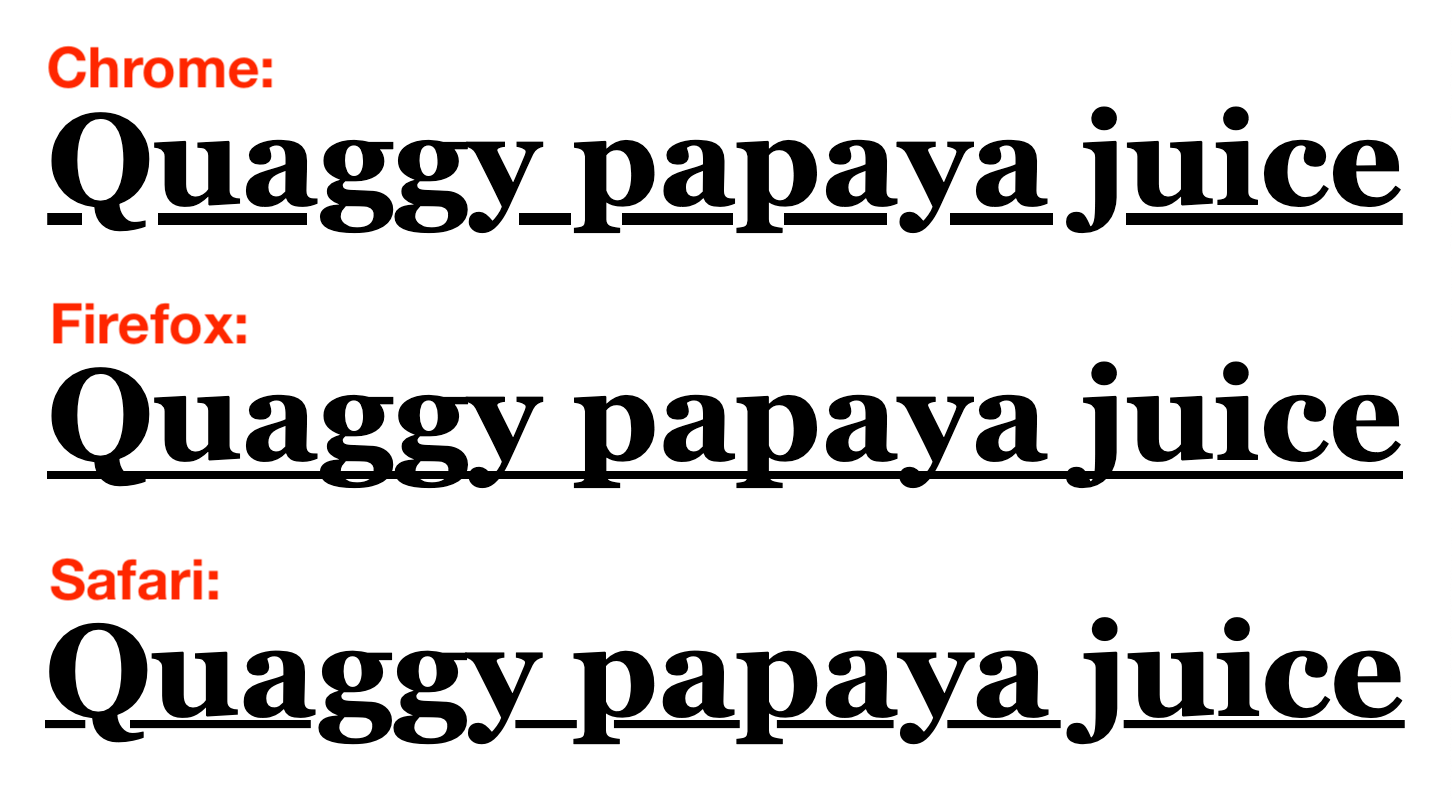
For some reason, they've gone to considerable trouble to avoid using CSS text-decoration to underline their links - which could be expected to work pretty well everywhere - and instead implemented custom "underlining" using an SVG background-image. I guess Safari on iOS doesn't position the background quite how they expected.
Designers: when you're tempted to do something like this, presumably because you think you know better than the browser precisely what an underline should look like... just don't.
I think they do that to avoid that thing were Chrome/Safari/etc do not draw the underline where the letters are: https://thepracticaldev.s3.amazonaws.com/i/er57ioliwktkhzeq7... (they want it to look like Firefox does in this screenshot but on all browsers)
It's funny because, back when Safari had just launched this, designers went crazy with ways of emulating it for those who didn't have Safari. Now they do the opposite. Designers are a plague on earth.


If we could stop spraying with neonicotinoids and start planting natural forage (basically just regular weeds), we could undo this in just 10 years.