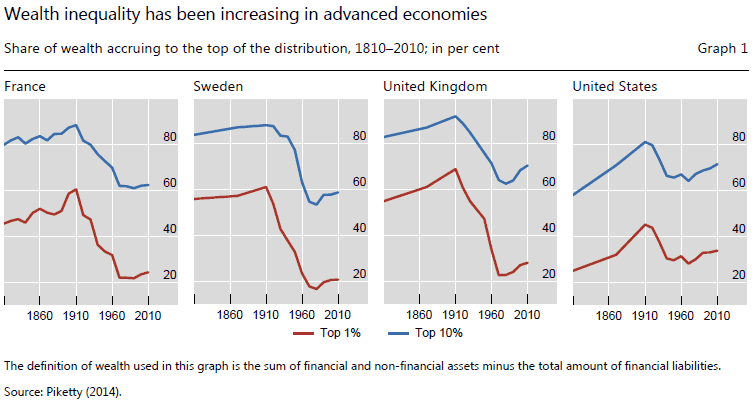
[1] has some actual numbers to answer that question, with e.g. [2] for modern US numbers (since [1] has only Europe). The wealth gap peaked in 1910, took a nose dive until the late 1960s (though much more pronounced in Europe than in the US) and is on the rise since then.
The post-industrial US dipped as low as ~1300 or ~1650 Europe, but is now back to levels Europe only reached in 1750, well on track to repeating the rising inequality during industrialization. Sweden is still at 1280/1600 Europe numbers, better than 1960s USA.
Actually it probably has risen a bit more since then since those are 2010 numbers, hence the comparison of US numbers to the French Revolution
1914-1918 is the more precise date range that you are looking at for causation.
One of the victims of war is Capital. Much Capital is destroyed in some places, and countries generally begin to do things that look an awful like command economics (i.e. Your factory is a tank factory now, you will make tanks, we will tell you how much you are getting paid. If you resist we will use the propaganda machine to make you look like our enemy). During both world wars the returns on capital were well below the rate of growth, and what would otherwise be expected.
On top of all that, the world wars were huge events for income taxes. If you look at a history of income taxes in the US, you see three local maxima for the top brackets. The Civil War, and the two world wars. The same is true of estate taxes in the UK, for example.
From what I gather a number of factors. As one article puts it: "Social solidarity engendered by the wars, wartime experience of governing the economy, unemployment in the 1930s and the rise of socialist ideas."
Both pension systems and labor unions were first created in the late 1880s/1890s and got a lot of steam in the early 1900s. Similarly with the modern iteration of minimum wages. Both the Nordic Model and Rhein Capitalism were created in the 1930s. On the more extreme spectrum, the Russian Revolution brought communism to Russia in 1917.
In a way you can see this as the fruits of the critique of capitalism by Marx in the 1840s. They grew and took root in light of rising unsustainable inequality and lead to mostly positive reforms that brought down inequality even in societies that retained capitalism at the core. Then the trend reverses as the US starts their war on Socialism and Communism, and Reganomics and Thatcherism become dominant.
I understand how those elements would lead to a decrease of wealth inequality past 1920/30, but it doesn't directly explain why the decrease seems to start before World War I.
If the unionizing and minimum wage movement was the cause of the big drop, wouldn't the drop have started before 1910?
Wouldn't the opposite be expected, an aristocratic caste system less equal than an ostensibly democratic society ostensibly based on fairness and human rights?
You're talking about expectations from economic theory, while I'm talking about expectations from societal values; or, in other words, the economy defining society, vs society defining the economy. Obviously the first is factually correct in the US at the moment, but I think the second is what most people believe/wish for. Worth noting that other capitalist countries put better brakes on those feedback loops, they're not inherent to the system.
What you're describing is "idealism" - the idea that people's ideas are not conditioned by the material conditions of their lives. That doesn't seem to be true. Instead, "The ideas of the ruling class are, in any age, the ruling ideas". Most people believe the things that are necessary in order for the conditions they live under to perpetuate themselves. People's ideas change mostly as a result of change in their material conditions.
After the Great Depresson and the second world war, most capitalist countries put brakes on those feedback loops in order to keep the whole system functional, especially in view of the apparent success of a socialist alternative. But those brakes have been in the process of being gradually stripped away since the 1970s, and even faster since the failure of the Soviet Union.
> Worth noting that other capitalist countries put better brakes on those feedback loops
Seeing how the wealth gap is increasing between them and the US, most politicians and wealthy individuals are doing all they can to remove those brakes, pushing evermore to follow the US. Defund, privatize, deregulate.
If you think the system is designed to do anything but transfer wealth from the poorest to the wealthiest, then you should seriously do some critical thinking on the subject.
How does a rich person existing affect me? Is it just because I'm jealous that I don't have a yacht and so I should try to overthrow the system that doesn't let me have a yacht? Even though I'll never get a yacht in any system?
Can we look at the graph of wealth disparity of America versus other nations?
Extremely rich people control every aspect of your life, how your city is planned, the state of the job market, the state of the economy, the laws, the state of the planet itself. One way that got a lot of attention lately is that extremely rich people prevent access to health care for everyone else.
Nobody has that much control. Human systems evolve from many different interests and lots of unforseen consequences. How are the extremely rich preventing access to health care for everyone else? The US is a democracy, people do vote and have a say in what they want their representatives to do. If universal healthcare was the priority for a majority of voters over time, it would have happened.
Don't be naive. Try to look at everything throught he lens that considers money is speech and corporations are people, and that the flow of wealth always, without exeception, flows from the poorest to the richest, and you will understand why it's a fallacy to think there is any good will involved, or that the ultra-wealthy are going to let you or I, the peasants, fuck up their plans.
Because the existence of these people means that we concentrate economic resources toward building yachts that might otherwise be concentrated toward growing food or building homes.
Rational economic actors who produce goods and/or services will tend to supply what there is the most economic demand for (what brings them the most profit). If half the population has almost none of the money, then their needs have little economic demand behind them. So then what is the economic incentive to supply them with the things they need?
In other words, producing a hundred-million-dollar yacht is a hundred million dollars (less profit margin) that could have been invested toward a more collective good, thus increasing the supply of those goods, thus reducing their scarcity, thus reducing their price.
> Before accounting for taxes and transfers, the U.S. ranked 10th in income inequality; among the countries with more unequal income distributions were France, the U.K. and Ireland. But after taking taxes and transfers into account, the U.S. had the second-highest level of inequality, behind only Chile. (Mexico and Brazil had higher after-tax/transfer Gini scores, but no “before” scores with which to compare them; including them would push the U.S. down to fourth place.)
A rich person certainly does not. Rich people as a collective class, however? You're kidding yourself if you claim that the people who make the laws and run our institutions aren't a nearly exclusive subset of the rich class.
Nevertheless, distributed power certainly is less dangerous than concentrated power, isn't it? Inequality is a metric of the overall concentration of such power in our free market society. More inequality means more power in the hands of fewer. They become more like kings each day, when does it stop?
Because of the Citizens United ruling by the Supreme Court of the United States, money is speech. Therefore the more money you have, the more speech you have, and the more speech you have the more loudly your voice is heard. The more money you have, the more political influence you have. Because of the Citizens United decision, the politicians are no longer beholden to the will of the voters, but to the will of the donors. The Supreme Court is not supposed to make law, that is the providence of the Congress, but here they made law. Money is speech and corporations are people. If you can't match their donations, you shut sit down and shut the fuck up because you do not count anymore with your pithy vote an no money to donate.
The average person is the average which includes some of the richest people on the planet, so I’m guessing you were thinking median?
While the sentence is likely true, the sister statement to it would cover historical relativism.
Society is generally expected to evolve and improve - this being the whole point of it.
So being absolutely better than the past is not as relevant to the conversation as how poor people are with comparison to their peers in their own country.
Right, so you agree. The problem is the floor, not the gap.
People like to point at a gap (in attainment or wealth or whatever) and pretend that this is all they really need to do, because the gap itself is evil. But that is nonsense, as demonstrated by my hypothetical. The gap itself is nothing and the context is everything.
So you can't just point out gaps. You need to articulate 1. what the people at the bottom are lacking 2. how closing the gap will ensure that the people at the bottom are better off afterwards (rather than just cutting down the people at the top).
i'm curious about the metrics you use for this comparison? such a different world with a lot of history that happened between now and then.
it's not exactly comparing apples to apples. working class americans have access to material goods but they don't have generational wealth like the aristocrats did. they don't have political power. they have to work everyday. they don't benefit from the class privilege. pretty significant list of all the differences.
I don't think much of that matters in the day to day.
What we do have is food, clean water, climate controlled housing, and sanitation - all better than the richest royalty of the time.
In revolutionary France one particular cold snap without enough logs on the fire could kill your children.
Our actual quality of life in the day to day far surpasses the aristocracy of revolutionary France.
You don't rebel because someone has a nicer car than you, you rebel because you're starving and miserable. We're just not. We're comfortable and mildly annoyed someone else is more comfortable.
this doesn't contend with any of the very real advantages i listed that aristocrats had versus today's working class. overall i disagree with your position. some people in my state died just the other day because of this system: https://vtdigger.org/2024/12/04/its-heartbreaking-death-at-b...
> You don't rebel because someone has a nicer car than you, you rebel because you're starving and miserable. We're just not. We're comfortable and mildly annoyed someone else is more comfortable.
very easy to say from our tech worker point of view!